
You Don't Know What You Don't Know: Leading with Curiosity in Anxious Times
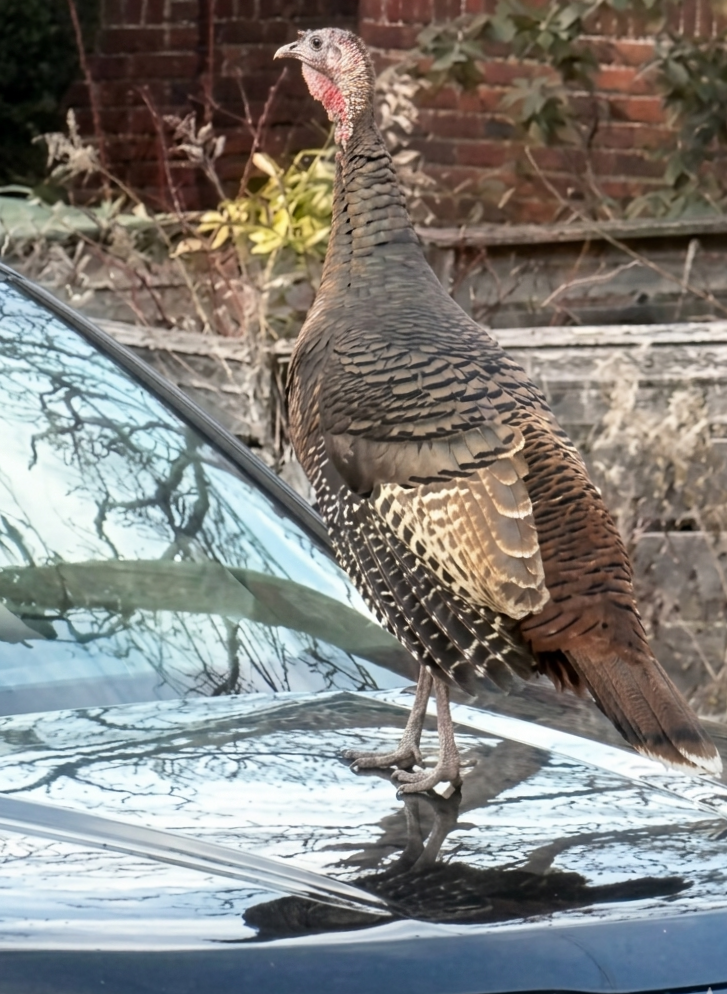
Today I spent twenty minutes watching a turkey fight with its own image reflecting off of my neighbor’s newly washed and shiny car. Now you may be thinking to yourself, “Wow, you really need a hobby”; and yet, it was truly twenty minutes well spent. After another long day as a leader in higher education, and a mom and partner in a complex family system, the metaphor of the turkey fighting the perceived threat posed by its own reflection was not lost on me.
There are days when a threat to my work, or my agenda, or my time suddenly appears. And there are days when, frankly, I have spent way longer than twenty minutes fighting what I perceive to be the threat, only to discover that the threat I perceived was simply my own reflection. Or more aptly, the threat was my perception of the situation, and my reaction to it.
But, sometimes we just don’t know what we don’t know, until we do.
In Peter Senge’s The Fifth Discipline Fieldbook; Strategies and Tools for Building a Learning Organization, Senge deftly names how “traditional management styles” have led to system failures and organizational collapse. Senge articulates these failures as systemic “learning disabilities”. The first learning disability that Senge says system leaders must contend with in order to prevent failure is, “personal identification with one’s position to a fault”.
As a systems leader, I spend a good deal of time seeking “fix it” solutions to problems. But how do I, as a leader, avoid acting like that turkey? What are the patterns of behavior that lead to wasted time and energy, attacking a perceived threat that is in reality just a reflection of my insecurity or fears.
Senge teaches us in his writing that leaders that over-identify with their position to a fault create team dynamics that employ reactive behaviors disguised as proactive behaviors, they center short term events rather than gradual processes, and they often ignore subtle problems until it is too late. These system failures result in teams, departments, or organizations getting left behind. And getting left behind, while others move ahead in a strategic mission, causes system anxiety and usually triggers the need to run like a turkey trying to find their flock.
Similarly, by the time the turkey figured out that the perceived threat was in fact his own reflection and gave up his determined battle, the gaggle of turkeys he roamed the neighborhood with had left him far, far behind. Finally turning his attention away from his own reflection, the turkey saw that he was all alone, looking frankly slightly foolish. He hopped down and began running frantically in search of his flock*.
How do we as leaders in higher education who are focused on finding solutions to a real student mental health crisis on college campuses avoid causing additional anxiety that can lead to isolation and system failure.
Anxiety is not the problem. The problem is being isolated and anxious about the wrong things.
The antidote to increasing institutional anxiety (and potential collapse), says Senge, is curiosity that leads to innovation. As leaders we must avoid attacking what we perceive to be the problem in an isolated role, rather than staying with the flock. And we must be curious together about the problems and the solutions in a way that focuses on more than individual job descriptions and “assigned duties” but curious in a way that brings a team's assets to the table of creative, playful problem solving. This, according to Peter Senge, is the foundation of leadership that builds learning organizations.
As a young social worker while working in the field of legal and medical advocacy for survivors of violent crime, my supervisor saw in me the tendency to isolate and solve problems on my own. In a weekly supervision meeting she said this to me, “Milly, tell me something you do not know.” I responded, “What do you mean? Clearly there is a lot that I don’t know.” She then explained that she wanted me to practice “not knowing” more often. And she officially made me the “I don't know! team member” for staff meetings for the foreseeable future. When something made me curious in a staff meeting and yet I did not know the answer or how to solve the problem, I was given the opportunity to exclaim, “Oh wait, I don't know!”, and then to encourage us as a team to find out more about how to solve the problem together. She saw how I showed up to staff meetings as a strength. I was curious, and curiosity is great. But she also saw my tendency to try and solve everything on my own and bring back answers to the team, and that was actually causing some conflict on our team. As a creative leader she leveraged my strength and turned it into an asset that was both humorous and created a more effective and inclusive team dynamic which in turn led to collective problem solving.
I think about this supervisor/mentor even now, especially now, in this new role of Executive Director of Wellness at Warren Wilson College. I am curious if you too think about how to respond as a leader when you realize you don’t know, or you are left wondering if you do. When we find ourselves at a decision-making table, and perhaps fear or judgement is palatable, how do you engender more curiosity and lean into creative problem-solving that brings your team along with you in the movement.
It is not up to us as leaders to decrease the anxiety or urgency in the teams we seek to lead. It is up to us to see, hear, and understand the right things to be anxious about and then to lead from a non-anxious place while offering intentional responsive direction in the process of collectively seeking creative solutions. I don’t know about you, but more often than ever these days I feel like I am in a leadership experiment, and the only real potential for collapse is leaving key stakeholders behind, not inviting the people most impacted by our decisions to the table, or burning out because I try to do it all alone and refuse to travel with my flock.
This is the core of the “Endeavor Experiment”. The Endeavor Lab is more than funding good well meaning projects. The Lab is a learning organization that takes seriously the anxieties of our times, and our jobs, and our world, centering the right things to be anxious about and then has graciously given us a powerful flock with which to innovate with. Then, as leaders, we take our curiosities back to our campuses, and learn even more about how our innovations can create the change needed, not just to keep our colleges financially sustainable, but to protect and support vulnerable young adults that our organizations know can become the next great leaders.
So, as we all continue to do the good work, here is what that silly turkey reminded me:
don't fight your own reflection too long,
check what you're anxious about, or what you think you know, and see if it is what it looks like to you. And, most importantly,
stay with your flock, moving calmly toward the collaborative solution building needed for real change.
Because no matter what our particular position is, we cannot meet this larger mission alone.
I lost that bird as he rounded the bend at the top of the hill, but I hope he found his flock. Either way, he reinforced an important lesson for me, so with gratitude “Gobble Gobble” little turkey.
*Sidenote: if you have not watched a turkey run, you have not truly lived.
Rev. Milly Morrow is the Executive Director of Wellness at Warren Wilson College in North Carolina.