Innovation as Shared Craft: Reflections of a Poet
Innovation is a slippery word, a shape-shifter that means everything and nothing depending on who wields it. Five years ago, when I was named Dean of Innovation at Randolph College, a title I have often said is among the more ridiculous in higher education, I was both amused and slightly embarrassed. The job itself resisted definition. Innovation, after all, is less a position than a perspective. It is a way of believing that something meaningful might be improved—through an idea, a method, a product, or some change in how we think or approach something.
I’ve never been particularly interested in defining innovation. It feels as unnatural to pin down as the way a poem decides to begin. I am a poet by training and practice, and in poetry we rarely talk about innovation explicitly. Every poem is already an attempt to work with language in a new way or to create an experience no one has quite crafted before. Innovation, in some respects, is the default setting in poetry.
Still, the work of the poet helps me understand the work of institutional change. A poem begins because the writer wants to carry something—an idea, an impression, an experience, a stubborn little phrase—from its spark to its readers. In colleges, we often hear talk of new programs or initiatives delivered with great enthusiasm, but when someone asks who will champion the project, the room falls silent. Then a name is tossed out casually, as if leadership were an incidental detail, as if a program could sustain itself on market demand or a donor’s gift. We’ve all seen well-funded initiatives collapse for lack of a passionate driver. I’ve seen lean, underfunded projects flourish because one sharp colleague became its champion. And I’ve abandoned more than a few poems because somewhere around stanza three I realized I had no real heart in them.
Innovation, like poetry, requires someone who is willing to love the thing enough to carry it forward.
But a poem doesn’t move from idea to publication alone. It needs readers, editors, and trusted friends. Even the most solitary writers rely on the quiet presence of others who offer “Try this,” or “What if you cut that?” or “What were you thinking?” The same is true of the work of the Endeavor Lab Colleges (ELC). Nothing significant in the ELC project, or at most of our institutions, has ever been the product of a single mind. The most successful initiatives hold a balance between empowering the individuals with the original vision and welcoming the community that refines and questions, not to diminish the project but to strengthen it.
Unfortunately, I’ve known quite a few writers who bristle at feedback, who feel misunderstood the moment someone asks a hard question. This is natural; we grow attached to the things we create. But if they can’t shake the defensive posture, they often end up giving up writing. When writers are at our best, we normalize critique and feedback. When this kind of support is seen not as a judgment but as a necessary stage in growth, faculty leading initiatives begin to read feedback the same way poets should: as a contribution, not a threat.
Innovation requires a system that cultivates both trust and challenge. When Sue Ott Rowlands arrived as our president four years ago, she often spoke about building a “culture of yes”—a campus where new ideas are greeted first with curiosity rather than suspicion. Too often in higher education, ideas are treated as disruptions to be managed rather than possibilities to explore. A culture of yes does not mean everything is feasible; it means most everything is worth a conversation. It shifts our initial impulse toward openness. This yes-mindset has a significant function–a kind of challenge to all of us to be curious about new ideas, and more significantly, to offer up our questions or ideas and see if they shift the tide or improve the original.
The Endeavor project accelerated this shift. The Endeavor Foundation’s investment gave our institutions the freedom to say yes more often, to explore wellness work that would normally be halted by fiscal, staffing, or logistical constraints. Ideas that once felt impossible became actionable. Endeavor didn’t just fund projects; it expanded our collective imagination about what was possible and helped us practice the very openness and trust that innovation requires.
For better or worse, I am the kind of person who always has a thought rising to the surface, a suggestion ready to slip into the conversation. At times this instinct is useful; at other times, it is an uninvited guest. Romeo, speaking of Mercutio, calls him “a gentleman…that loves to hear himself talk,” and while I would like to believe I listen more than that, I also know my enthusiasm for offering counterpoints can interrupt the type of progress I want to support.
When we first began the Endeavor project and gathered in our virtual rooms to discuss curriculum and wellness, I felt that familiar impulse. I had to quiet myself, at least as much as I could, in order to learn from the room. Soon, we found ourselves rekindling a curiosity that can be harder to access on our own campuses. As we explored each campus's activities and needs around well-being, we were infused with new ideas and questions, and sought the right space to share ideas that would work for the collaborative. We tried to say yes to collaboration, accepting that the work would vary across our campuses. Those differences didn’t diminish the co-creation; they enriched it and broadened what was possible. We are now two and a half years into this journey together and have become each other's trusted collaborators in the shared partnership to champion well-being.
In the first poem of my collection, there’s an image of a “fountain cherub,” offered years ago by my graduate professor when my own metaphor wasn’t quite enough. I resisted it, tried to write something better, but eventually recognized that his suggestion carried the poem better than anything I could manage alone.
I have thought about that moment occasionally while working on the Endeavor project, especially as we’ve been drafting an articulation statement on the liberal arts and wellness. Every paragraph of our work bears the investment of multiple collaborators–one person offers the initial line, another sharpens it, someone else revises the structure, and another removes what no longer serves. No single author can claim the text; its authorship is shared, its strength communal. The document becomes clearer because we’re willing to let each other improve it. We welcome the unexpected phrase that suddenly makes the whole thing work. Even in this work, it’s often best to accept the fountain cherub.
Eventually, if we’re lucky, we become the beneficiaries of a shared experience, one in which the work has evolved through all of us. The poet would say the poem begins to guide us. The initial concept, the thing that once felt central, falls away, replaced by the shape the work itself demands. Institutional innovation and collaboration works like this too. A new initiative meets reality, bumps against competing needs, budget constraints, or community culture, and it begins to change, accepting its revisions. What remains is usually better than what we started with.
Curricular and systemic innovation and collaboration are not the same as writing poetry, though some days I insist that poetry is more difficult. Poets need to maintain their mystique, especially on the days when the words refuse to align. But when the poems won’t come, there is a certain comfort in turning toward the projects we love and asking, as we do with language, how they might be made just a little better.
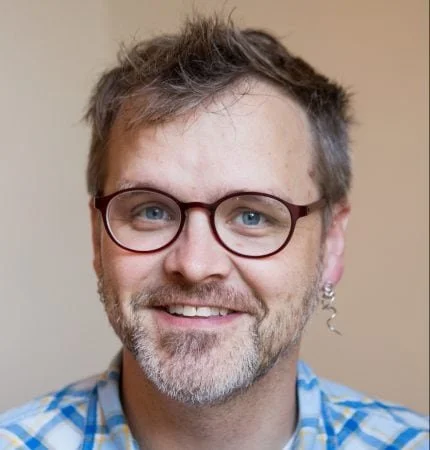
Gary Dop is a Professor of English & MFA Director at Randolph College in Virginia.