
In 2024, through an Endeavor Lab Colleges’ (ELC) professional development opportunity, I was introduced to Pepperdine’s Resilience-Informed Skills Education (RISE) program. As soon as I learned about it, I saw a golden opportunity. As the Associate Dean of Advising and First-Year Forum—a year-long course comprising 11 sections led by faculty-student teams—I wanted our peer leaders to be more than just guides; I wanted them to be resilience coaches. The goal was to help first-year students navigate the "big transition" to college, develop a series of resilience strategies and to maintain those strategies for life.
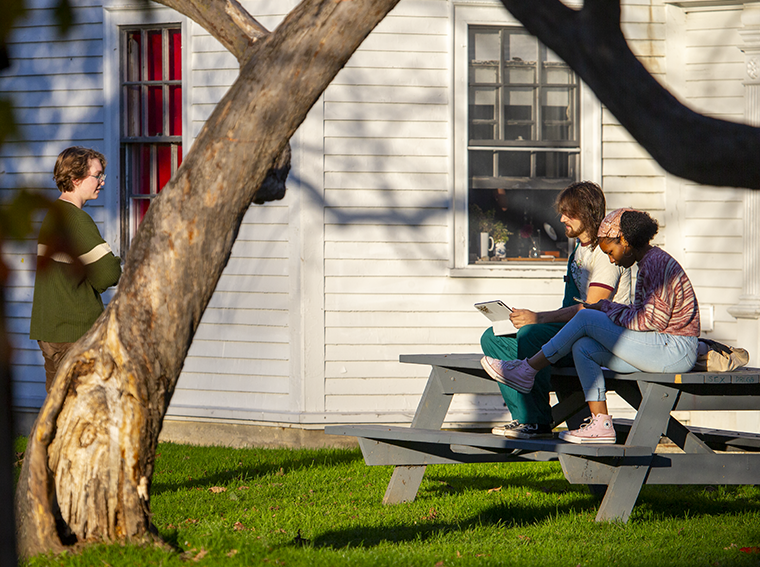
Implementing RISE was remarkably straightforward. In less than a day, Pepperdine colleagues trained our co-leaders to guide freshmen through identifying practices for well-being across six dimensions: Physical, Social, Cognitive, Spiritual, Service, and Life Skills. Our peer leaders were not acting as counselors or life coaches; their role was simply to elicit the students' own solutions. We integrated the program directly into the syllabus: students completed an intake form in class, and the resilience-building activity with a co-leader was assigned as homework. The impact was immediate. It provided practical support for freshmen and gave our senior co-leaders a more robust role.

When I asked the co-leaders how the RISE program was proceeding, I realized that both seniors and first years had taken the RISE rules as a flexible frame within which they could let their conversations twist and turn, leading more to friendships and connections than solid plans to increase resilience. I was happy with the outcome nonetheless, since friendships and connections do help resilience and persistence in college. Another unexpected outcome was the faculty’s response to RISE. While critical of the program’s structure for one reason or another, the First-Year Forum instructors admitted that conversations about specific aspects of a student's resilience during advising time were not only helpful but also necessary and welcome. This, to me, represented a change in the usual refrain that always goes something like “We don’t teach well-being; we teach [insert field of expertise].” It was one of the several insights I gained and that helped me contribute to the work done by the ELC Curriculum Working Group as we discussed and designed our nine dimensions of well-being: checking on students’ well-being as advisors is also in the hands of faculty members. Advising provides a perfect frame for supporting the whole person and connecting academic success with well-being.
However, at Bennington, the "Spiritual" dimension sparked a firestorm.
As framed by Pepperdine, as a Christian-based institution, the concept of spirituality was couched in "faith"—specifically the slide title: “Adopt a Faith Perspective.” Before we launched, my Pepperdine colleagues warned me this might be polarizing and offered to remove it. I gave them a firm "no." If we are the open, pluralistic institution we claim to be, we must acknowledge that many students are grounded in faith or spirituality to navigate the world.
My colleagues were right. During the training, I faced opposition around the inclusion of the spiritual dimension of the program. A few vocal seniors argued the spiritual dimension was a "thinly veiled" attempt to promote a Christian outlook, and they were offended by the presence of religion in any form.
I couldn’t win the argument, no matter how good the examples I provided of students needing to nourish their spirituality. The seniors, students themselves, felt ill-equipped to handle their peers' spiritual needs—even though the task was simply to ask if needs in that dimension were being met. Ultimately, we made the collective decision to cut the spiritual dimension from the program.
Was it the right move? It was the easy one, but it felt unfair. It felt like a disservice to the very students we were trying to support.
I’ll admit, the RISE trainers' attempt to redefine "faith" as merely "belonging to a group" felt stretched and hollow; but it can’t be denied that resilience is often rooted in how we nourish our spiritual lives. Two years later, I am heartened by the ELC’s 9 dimensions of well-being and the work of the Curriculum Working Group, including the development of our (draft) white paper, “Framing Well-Being & Whole Person Education in the Liberal Arts.” While not pushing students to adopt a “faith based approach”, the ELC’s 9 dimensions makes an effort to better define pluralistic spiritual well-being and takes a stand: acknowledging spiritual needs of students who practice them should be a priority even on secular campuses.
If I had to make the choice today, I would not cut spirituality and faith-based practice from a list of critical resilience building skills. We should not shy away from any of the dimensions of well-being that contribute to our students' ability to achieve a life well lived in a complex and interconnected world.
Dr. Barbara Alfano is the Associate Dean of Advising and First-Year Forum at Bennington College.