
Free Play: Cultivating Student Engagement Through Improvisation and Contemplative Practice
In a recent meeting with some of my peer tutors, I pitched the idea of dressing up as a squirrel and handing out acorns to students in Main Hall. Yes, the thought was a bit off the wall (Randolph’s mascot is a Wildcat), but my suggestion wasn’t just for kicks–we’d been brainstorming other ways to promote Randolph’s Academic Strategies Program, which provides peer support for general academic skills like time management, organization, and note-taking. While any student can access this service electively, it’s also a requirement for students on academic probation, which can make promotion crucial, and sometimes challenging. After a largely subdued discussion around flyers and orientation efforts, the team lit up with laughter (and probably disbelief) when I mentioned the squirrel suit. The image of me, their buttoned-up supervisor, rodently-robed with a big bushy tail, seemed to be the missing ingredient in our discussion. Little did they know, I’d already added the suit to my Amazon cart.
Under each of my hats–as an English instructor, poet, artist, musician, and the Director of Randolph’s Academic Services Center and Writing Program–I’m so often reminded of the profound and expansive power of play: the way it can silence our inner critics and open up space for safe and meaningful connection—sometimes, it's the only thing that can. Getting students to “show up,” particularly over the last several years, has often felt like an uphill battle. The perceived need, for instance, to write a perfect first draft is often the biggest barrier to students getting their thoughts on the page (as a writer, I understand this challenge all too well). Likewise, in the broader context of academic support, I’ve found that workshops on skillsets like time management and note-taking are next to useless if students don’t feel safe or comfortable enough to attend in the first place. The fear of uncertainty, broadly speaking, is among the most formidable barriers to academic flourishing. As educators, how do we respond?

Of course, no antidote can singularly address the far-reaching challenges faced by today’s college students; however, two practices have been consistently (and increasingly) foundational in my own work with students: play, particularly forms of improvisation, and contemplative practice. Though certainly distinct, these two practices aren’t as different as one might expect. In combination, they may be just what’s needed to cultivate the safety and belonging necessary for a flourishing college experience.

In the prologue to his book Free Play: Improvisation in Life and Art, violinist and poet Stephen Nachmanovitch explores the old Sanskrit word lila, which he defines as “divine play, the play of creation, destruction, and re-creation, the folding and unfolding of the cosmos.” Nachmanovitch sees play, particularly improv, as a serious and essential mode of learning, one that encourages risk-taking and collaboration and invites curiosity and presence. Play delights in process over outcome, engagement over perfection, allowing individuals to focus on and enjoy the task right in front of them, to be in the moment. In an age of TikTok and relentless social media feeds, such practices aren’t just helpful, they are absolutely necessary for deep and critical thought.
Higher education is often perceived as a “serious endeavor” and thus counter to play; however, qualities like openness, curiosity, and presence allow students to cultivate resilience and, consequently, adapt to the challenges they will undoubtedly face during college and their life beyond it. Students need to know that it’s okay (and sometimes necessary) to show up and fail. They need to feel supported, affirmed, even energized by their participation, not only driven by expectations and outcomes. They need opportunities to take risks without judgment, to immerse themselves fully in the tasks at hand, to embrace and grow from their mistakes, to be spontaneous.
In a recent New York Times article “Yes, Improv Comedy Sucks. And Everyone Should Try It.,”writer Nicolaia Rips recounts her experience joining an improv comedy class to address her chronic anxiety and indecision. “If all the world’s a stage,” she writes, “then I had stage fright.” These days, the world is perhaps more of a stage than Shakespeare could have even imagined–through social media alone, we have become perpetual spectators of each other’s lived experience and, equally, the performers, with eyes on our every move (or post). That’s a lot of pressure. Fortunately, that’s where improv excels. “The reason you can’t win an improv game,” Rips realizes through her own experience, “is because there are no correct answers. The only time you fail is when you avoid making a decision at all.”
Reflecting on my undergraduate experience, the most pivotal moments were often propelled by forms of improv. In fact, I’m not sure where I’d be if it weren’t for my own first-year writing instructor, who punctuated his classes with puppet shows, comedic mock courtroom trials, and love letters to bricks. His classes were rigorous, and equally playful. Despite his high expectations, even the concept of a grade in his course seemed strange (and almost irrelevant) in the context of whatever antics he threw our way. And therein lived the magic–to be thrown into the process and encouraged to be there, to commune there, to resist outcomes and, in doing so, exceed even our own expectations. As someone focused so intently on getting a good grade, I needed this brand of immersion.
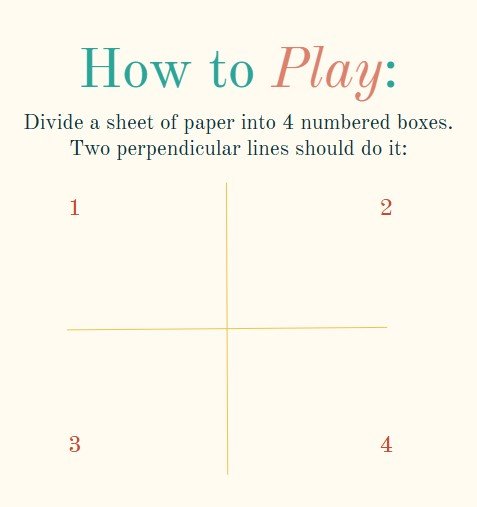
I can’t, with expertise, speak to all the ways such practices translate into other areas and disciplines in higher ed, but I’ve seen it happen enough (at Randolph and elsewhere) to know there’s a place for play, for active curiosity, in just about every corner of the enterprise. In my own writing courses, I have increasingly used improvisational exercises as entry points into discussion. One activity I’ve found particularly useful is a version of Viola Spolin’s Writing Game, in which participants are asked to bounce quickly between various modes of writing (poems, letters, how-tos, even doodles) without over-thinking or worrying about the end results. Sometimes I’ll play John Coltrane in the background, or Keith Jarrett. Sometimes, just for fun, I’ll speed up the process, requiring students to jump between modes of thoughts every few seconds. Sure, few students leave this exercise with a polished piece of writing, but most seem energized and empowered by the process. They seem more open, curious, and present.
Speaking of presence, mindfulness-related practices have become equally integral to my work with students over the last several years (and to my own personal well-being). In both the classroom and in my work in academic support, I’ve sought to weave moments of mindfulness into the schedule, even if that’s just a couple minutes of silence to offer space for reset. In the Summer Transition at Randolph (STAR) Bridge program, for instance, I welcome each first-year class with “A Brief Mindful Moment” in which I invite students to check in with themselves, mentally and physically, and to acknowledge the unique community they’ve created just by showing up. While this activity may catch some students by surprise, it also provides a mutual space for students to participate openly and honestly, and the discussions that follow tend to be more reflective, open, and compassionate. Other practices have included mindful nature walks and explorations of the senses–I’ve found my Vibra-Tone bell particularly useful in exploring sound and for punctuating the end of practices.
Participation in the Endeavor Lab Colleges (ELC) Collaborative has offered me the space and support to think even bigger, to imagine new ways of weaving such practices across campus, not just within the classroom or the walls of my department. Even before joining the Endeavor team, I attended several ELC-supported professional development opportunities that highlighted ways other institutions were incorporating play-based and mindfulness-based practices into the curriculum. A trip to the University of Wisconsin-Madison’s Art and Science of Human Flourishing workshop, for instance, did so much to bridge my own personal mindfulness practice with the work I was doing in student support. I’ve since participated in extended training opportunities from Mindfulness Institute for Emerging Adults (MIEA) and UC San Diego’s Mindfulness-Based Stress Reduction (MBSR) programs. Not only have these opportunities informed my work in higher education, they have been useful for cultivating more equanimity in my personal life, which I would argue is a prerequisite for meaningfully integrating such practices into an academic context.
Since joining the Endeavor team, I’ve also had the opportunity to collaborate with colleagues and students I’d never met before, to dive deeper into some shared values and visions for Randolph’s campus. Importantly, it has shined light on the many wonderful ways the Randolph community was already working to support itself through acts of play and mindfulness-based practices. Over the last few months, my own goal for NatureRx has shifted from simply developing more programming to finding ways of sustaining and collaborating on efforts already underway, to developing a framework for mutual support, a movement greater than its parts. To this end, next fall, Randolph’s NatureRx team will launch a new vehicle for such efforts, particularly those that incorporate or combine elements of play, contemplation, and nature. We’re calling it Widening Circles, based on a poem by Rainer Maria Rilke.
Widening Circles will aim to nurture belonging through an exploration of our broader “ecologies” and an emphasis on process over outcome, play over perfection, community over competition. In this spirit, these workshops will seek to empower the Randolph community–students, faculty, and staff alike–to broaden their circles of contact through regular acts of play and shared intentionality. No small task, of course, but I’m excited by all that next year has in store. In the meantime, I’ll be testing out my new squirrel suit, smoothing out the wrinkles, trying to keep my own inner critics in check.
Grant Kittrell is the Director of the Academic Services Center and the Writing Program at Randolph College.